The last time I entered a local art award was in 2013, the City of Stirling Art Award. A decade on from that award, I thought it was time to put my work in front of judges again, so in 2024 I submitted this drawing to the City of Rockingham.
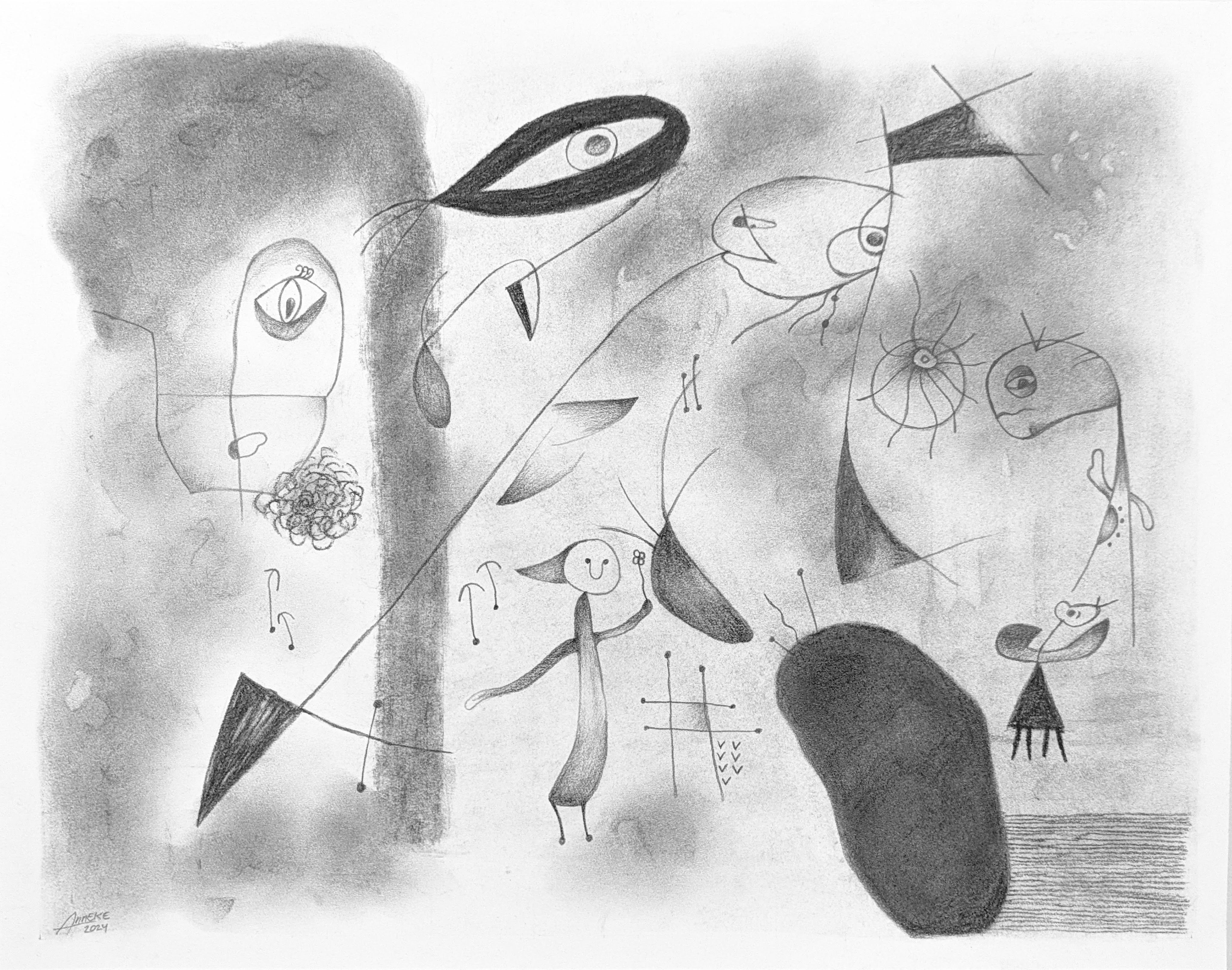
It wasn’t selected.
After a decade of not putting my work in front of judges, I decided to play it safe. No experiment. No new concept. I borrowed Miró’s language of floating eyes, small figures, and lines that wander off on their own. I worked in pencil and graphite, the media I have trusted for most of my life as an artist. I told myself: this is different, it’s conceptual, the technique isn’t bad. This one will make it.
It didn’t. The judges decided otherwise.
Of course I was disappointed. But the worst part, and the part I’m not proud of, was the small spiral that came afterward. I’m not that good. I don’t have the technique. I’m just self-taught. That voice was loud and clear, and it wasn’t the first time I had heard it.
It drowned out a meaningful comment from my former Beginner Painting professor, David Hoppe, who, if my memory does not fail me, once told me: “Your ideas for your projects are uniquely creative. You work with passion. I think you’re in the wrong major!” I have found my creative footing in other places: solving technical problems nobody had a name for, writing processes and procedures that helped people. But when it came to creative making, my confidence was nowhere to be found.
Then a different question arrived, and it has not left.
What defines my work? Is it about what others think of it? Is it about what the market wants? When did this thinking become the thing that decides?
When I looked at the drawing again, I saw that every choice in it was a prediction of reward. It should get accepted. It should catch a buyer’s eye. It should sell. I should earn some extra cash. The drawing is competent. But the mind that made it was not asking what is true here. It was asking what will be chosen.
That is when I realized I had strayed a long way from the joy of creating. And I understood something else. I no longer think the drawing failed. It succeeded as evidence. It is a record of a person facing uncertainty and handing the decision to someone else.
I don’t think this is only my story. I suspect most artists, trained or self-taught, know some version of it: the quiet calculation of what will be chosen, running underneath the making. I carried mine for years without seeing it. It felt like caution, or good sense, or simply knowing the market. It took a rejection to make it visible, and once it was visible, I couldn’t stop seeing it.
What has changed is that I now notice. Not after the work is finished, but while I’m making it: the moment my hand reaches for what will be chosen, and the moment it reaches for what is true. I can’t always stop the first. I can at least see it happening.
This is what The Art of Uncertainty is, for me.
It is not really about the vessels or the pastels, or anything else I make. I think of them as the residue of the work underneath: the thinking, the doubt, the pull between what I want to make and what I expect to be rewarded, the moments I trust myself and the moments I don’t. I’m learning that uncertainty is not an obstacle I clear before the art begins. It is the material I work with.
So as you move through this site, I’d invite you to look at each piece as a trace of a decision. Where did the maker hesitate? Where did she stop asking for permission?
I’ve come to suspect that my small spiral after the rejection was not only a personal flaw. It may be something much older. Ancient, perhaps. Every human who has faced an unknown, whether a hunter, a healer, or a maker, has had to decide what to do without knowing. Some of us reach for authority. Some reach for the group, or for what worked before. Some take the leap. I wonder whether somewhere in us there is an inherited way of responding when the ground goes soft.
How do humans actually deal with uncertainty? What do we do with our hands, our bodies, our fear? And what happens when we notice ourselves doing it?
That is where I would like to begin next.

